Sunday, February 11, 2007

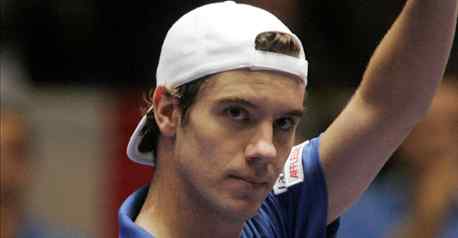
Gasquet sends France through


Richard Gasquet beat Andrei Pavel 6-3 6-2 7-5 to give France an unassailable 3-1 lead over Romania in their Davis Cup first-round tie.

Gasquet took one minute less than two hours to secure the victory that sends France into a quarter-final away against either Chile or holders Russia whose first-round tie.

The French world number 16 did not take long to gain control against Pavel, a former top 20 player who has dropped into the 100s due to injuries.

Gasquet did not once have a break point against him as he took the opening two sets comfortably but the Romanian made more of a match of it in the third.

Pavel went 3-1 up after his first break and then 4-1 ahead before serving for the set at 5-3, but an unlucky net cord and a double fault by the Romanian handed the initiative back to the Frenchman who took three successive games for the victory.

Gasquet had also won his singles against Victor Hanescu on Friday when Sebastien Grosjean overcame Pavel but the Romanians took the match into the third day with their doubles victory on Saturday.

Baseball gets into full swing

The Drury baseball team is getting ready for its first season of play since 1972 to begin.

The first official game will be Friday, Feb. 9, but team members already have been working hard. They held fall practices from Sept. 5 to Oct. 6. Since then they have spent eight hours per week in conditioning, weightlifting and drills.

Head coach Mark Stratton, assistant coach Byron Hagler and graduate assistant Coach Scott Nasby are in charge of the team.

"The guys are working to get in the best physical shape of their lives," says Stratton while adding, "and so far, so good."

Recruitment for the team began in 2005. The roster now includes 30 players; two were already day students at Drury, 10 have transferred to Drury and 17 are new freshman.

"The strongest points of the team are athleticism, pitching, depth of talent and defense," says Stratton.

The coach noted that Great Lakes Valley Conference rules require wooden bats, which typically don't produce as many home runs as the metal bats used by many college leagues.

"Run productions will be based on doing the little things, such as bunting, advancing runners, executing the hit and run, sacrificing, controlling the oppositions running game, and not sitting back and waiting for a home run," Stratton predicts.

Stratton does concede that the lack of experience might be a problem. However, he says that in five years, he would like to be "coming off of a trip to the Elite Eight in Birmingham, Alabama, with our 17 seniors carrying the 2010 NCAA D-II Baseball National Title trophy."

With practices and workouts, a 35 game regular-season schedule, the Great Lakes Valley Conference Tournament, the North Central Regional and possibly the NCAA-II World Series in their season, the team members have been - and will continue to be - extremely busy.

"It is hard to find time for a social life outside of baseball," freshman player Sam Pirtle said. "Depending on your major and nightlife, weekdays usually consist of doing homework."

London media circus discovers people with funny accents

The UK television industry, based exclusively within Greater London, is on the cusp of a linguistic revolution, we can reveal.

Following a series of successful test programmes featuring a man from "Wales" reading the news and a young gentleman from the city of "Newcastle" as a narrator, TV producers have decided to allow more people who speak funny onto our TV screens.

The dramatic change will bring mainstream television in line with the more culturally aware TV programmes such as drama, which have enjoyed the ironic nature and peculiar philosophy of those that live above the Watford Gap for many years now.

"I have already signed one man from Liverpool, where the football club is," one producer confided. "He sounds just like John Lennon used to talk, which is great because we're planning a 60s season from the autumn."

"I've got one from Scotland," another excitedly explained. "It's either Glaswegian or from Edinburgh. I can't understand a word it says, but then that's all the rage with this new approach to inclusive programming."

The startling trend is believed to have stemmed from BBC Producer Pippy Rover, who, taking an ironic holiday in Britain in 2000, came across an enormous number of people who were able to communicate with each other but did so in a most peculiar manner.

Sporting a black poloneck and light-grey sports jacket, Rover told The Rockall Times: "However, I soon realised they were talking English but in a funny accent. I was appalled at the time but I later realised the untapped potential for using these people to appeal to their own kind."

Since that dream, Rover has faced an enormous amount of criticism from within the media concerned about "dumbing-down" and the continued inclusion of non-Oxbridge candidates in the industry, but has ultimately triumphed.

However, while people with "regional accents" — as they have become known — are now allowed on the screen, TV bosses told us there are no plans to move the industry itself out of London. "Can you imagine what would happen?" one asked rhetorically. "I mean, we've got one or two spots in Manchester and Nottingham because it's cheaper up there, but can you seriously imagine people from outside London making decisions about what programmes appear on our screen? It would all be about pigeons or rap music or working-class bingo players — and all without a drop of condescension."

Mayo Clinic Discovers a Key to "Low Metabolism" -- and Major Factor in Obesity

ROCHESTER, Minn. -- Wiggle, walk, tap your toes, shop, dance, clean your basement, play the guitar to boost your NEAT -- or if you're a scientist, your "non-exercise activity thermogenesis." Mayo Clinic researchers report in today's issue of the journal Science that NEAT -- more powerful than formal exercise -- determines who is lean, and who is obese. Obese persons sit, on average, 150 minutes more each day than their naturally lean counterparts. This means obese people burn 350 fewer calories a day than do lean people.

James Levine, M.D., is the Mayo Clinic endocrinologist who led the study. His research team explored the specific links between inactivity, low energy expenditure and obesity in an effort to devise new treatments for obesity, a public health epidemic.

"Our patients have told us for years that they have low metabolism, and as caregivers, we have never quite understood what that means -- until today," says Dr. Levine. "The answer is they have low NEAT, which means they have a biological need to sit more. A person can expend calories either by going to the gym, or through everyday activities. Our study shows that the calories that people burn in their everyday activities -- their NEAT -- are far, far more important in obesity than we previously imagined."

He adds that the NEAT defect in obese patients doesn't reflect a lack of motivation. "It most likely reflects a brain chemical difference because our study shows that even when obese people lose weight they remain seated the same number of minutes per day," says Dr. Levine. "They don't stand or walk more. And conversely, when lean people artificially gain weight, they don't sit more. So the NEAT appears to be fixed. But as physicians, we can use this data to help our obese patients overcome low NEAT by guiding the treatment of obesity toward a focus on energy as well as food. We can encourage NEAT-seeking behaviors."

About the Study: Special Underwear

More than 150 personnel were involved in the planning, design, invention, food preparation and data analysis required over the course of about 10 years to produce this comprehensive study of the comparative energetics of lean and obese adults. To detect even the smallest tap of the toe, Mayo Clinic researchers invented a movement monitoring system that incorporates technology used in fighter-jet control panels. They embedded sensors in customized, data-logging undergarments that the researchers designed for both men and women. This allowed monitoring of body postures and movements of 10 obese people and 10 lean people every half second continuously, 24 hours a day for 10 days. The test subjects were healthy recruits who lived and worked in Rochester, and went about their normal routines during the study period. Only two things were forbidden: swimming and eating food the research center did not prepare.

Researchers issued fresh undergarments each morning at the hospital where the test subjects took all their meals. At this time the subjects were weighed, and the data on body position and activity from their underwear movement monitoring sensors was downloaded onto a computer.

"This instrumentation appears slightly bizarre as it gives us a covert window into people's energetics and every activity in a completely unthreatening way," says Dr. Levine. "But because of it, we have a window into people's activity life that no one's ever had before."

Role Reversal: Lean Become Stout; Stout Become Lean

For the next phase of the study, the researchers overfed the lean people by 1,000 calories a day to make them gain weight, and underfed the obese people by 1,000 calories a day to replicate an intense diet. Researchers then monitored their movements every half second for 10 days and compared the results. Even after losing weight, the naturally obese group sat more and moved less. And even after gaining weight, the naturally lean group stood, walked and even fidgeted more than the other group. The researchers' conclusion: Obese people are NEAT-deficient, perhaps as a result of a neurological defect in processing biological drives and environmental cues.

Implications

The Mayo Clinic researchers believe the discovery of the effects of NEAT on obesity is so strong that it should be used to prompt a "NEAT revolution" to reverse the epidemic trends of obesity. "This is entirely doable, because the kind of activity we are talking about does not require special or large spaces, unusual training regimens or gear. Unlike running a marathon, NEAT is within the reach of everyone," Dr. Levine says.

So promising is the role of NEAT in explaining obesity that Dr. Levine believes further studies are warranted to help expand scientists' understanding of the biology of obesity.

Collaboration and Support

In addition to Dr. Levine, members of the Mayo Clinic research team include: Matthew Clark, Ph.D.; Michael Jensen, M.D.; Paul Kane; Alisa Krizan; Lorraine Lanningham-Foster, Ph.D.; Shelly McCrady and Leslie Olson. The study was supported by grants from the National Institutes of Health; Mr. and Mrs. T.S. Ward; the Minnesota Obesity Center and Mayo Foundation.

10 Neat Things to Know About NEAT:

The most detailed and data-rich study of obesity ever undertaken was performed at the Mayo Clinic and published January 27, 2005 in the journal Science. Results show that it's metabolically more effective to put more NEAT -- "non-exercise activity thermogenesis" -- into your life to achieve a healthy body weight, than to seek organized exercise.

To prepare, design and carry out this NEAT study over the past decade, Mayo Clinic brought together:

  • 20 study participants who were willing to forgo Christmas peanut brittle, Halloween Milky Ways and all restaurant and home meals. Every meal had to be taken at the hospital, without exception.
  • A biomedical team at Mayo Clinic of approximately 150 people, ranging from endocrinologists, dieticians to specialists to conduct analyses with a mass spectrometer.
  • The periodic $1,000/person glass of water. This was a special metabolic test that required drinking treated water with tracers to monitor the person's metabolism as a way of providing researchers a measure of compliance that test subjects were eating only meals prepared for them by hospital staff.
  • A dedicated kitchen staff to cook 20,000 meals over the test period, starting at 5 a.m. each day --without skipping a beat, food group or strange hankering.
  • 150 million lines of data was downloaded from the data-loggers and analyzed.
  • Committed study participants to clean their plates -- and scrape them, too, with a rubber scraper -- so every calibrated calorie that was served was also consumed.
  • Custom-made, data-logging undergarments that all participants wore 24 hours a day, exchanging a new pair every morning at the hospital at breakfast. The bottoms look like bicycle shorts and the women's tops look like sports bras. The men's tops look like undershirts.
  • Jet fighter control panel motion sensing technology embedded in the special underwear to monitor every tilt and wiggle of the participants.
  • No swimming -- due to the potential water damage to the motion sensors.
  • No particular activity regime was endorsed or prescribed. Participants were told to go about their normal work, recreation, rest and romance routines.
  • Says James Levine, M.D., the Mayo Clinic endocrinologist who led the study: "This was a massive team effort. It should be said that this collection of teams at this level of expertise don't appear anywhere else in the world."

    Mayo Clinic is now using Pathfire's Digital Media Gateway (DMG) for distribution of video news releases, to streamline our services and provide station staff with content that is easily accessible when they need it. On the left side of the DMG main page, click on the VNF Master Locator and search for MayoClinic0014, or look for the resources in the Video News Provider B section.

    If you have questions or problems in locating the story, contact Pathfire Customer Support at 1-888-345-0489 or support@pathfire.com. If you do not have access to Pathfire's DMG, and would like access to Mayo Clinic's video resources by satellite or other means, please call 507-284-2333 or e-mail: swai.reesa@mayo.edu.

    For stations without Pathfire access, the video resource is available at no charge to news media at www.thenewsmarket.com. You can receive broadcast-standard video digitally or by tape.

    ###

    To obtain the latest news releases from Mayo Clinic, go to www.mayoclinic.org/news. MayoClinic.com (www.mayoclinic.com) is available as a resource for your health stories.
Astro major discovers new star in Beta Crucis complex

A team of researchers affiliated with the Swarthmore physics and astronomy department has discovered a companion star to Beta Crucis, the nineteenth brightest star in the sky.

Led by Associate Professor of Astronomy David Cohen, the research team includes fellow astronomy professor Eric Jensen, Michael Kuhn ’07 and West Chester University Assistant Professor of Astronomy Marc Gagné. Jensen and Cohen launched the project two years ago, “but it really got off the ground last summer when Mike Kuhn started working on it,” Cohen wrote in an e-mail. The team will submit a paper on its findings to The Monthly Notices of the Royal Astronomical Society for publication.

According to the Jan. 9 press release, the discovery was made largely by accident. The project undertaken by Cohen, Jensen and Gagné originally aimed “to study how the X-ray emission properties of very luminous, massive stars change as one looks from the absolutely most luminous ones … to somewhat less luminous ones,” Cohen wrote.

The emission data of Beta Crucis was especially pertinent to Cohen’s field of expertise. “[Cohen] had originally been interested in [Beta Crucis] because he studies X-rays from hot stars,” Kuhn said. “More massive stars,” like Beta Crucis, “also tend to be hotter and more luminous.”

When they noticed the significantly less luminous star in the vicinity of the Beta Crucis complex, the research team developed “the hypothesis that this was a companion star, first of all, and then that it’s a pre-main-sequence star,” Kuhn said.

Pre-main-sequence stars are still developing, unlike Beta Crucis, which is nearing the end of its life as a main-sequence star.

Using instruments such as the Advanced CCD Imaging Spectrometer and the High Energy Transmission Grating Spectrometer in conjunction with NASA-designed X-ray data analysis software, the team downloaded X-ray data from the Chandra space telescope to computers in the Science Center astronomy lab.

Companion stars are often observable using less complex data collection techniques than those involved in “characterizing X-ray properties” of main-sequence star beta Crucis, which was the principal goal of data analysis, according to Cohen.

At least one other companion star to Beta Crucis had already been identified prior to this project’s undertaking. Over the course of data collection, the research team “noticed this other object, which happened to not have been noticed before … This was really odd that it hadn’t been discovered before,” Kuhn added.

The “other object” is most likely a companion star to Beta Crucis, which means that the two stars are gravitationally bound and both are around eight to 11 million years old. “We think they’re gravitationally bound, but we need further observations to actually prove that,” Kuhn said. “If they’re moving in the same direction then they’re probably bound. If they’re not, then they can’t be bound,” Kuhn said. Future experiments are currently in the planning stages.

The project was jointly sponsored by the college and the federal government. In addition to a Eugene M. Lang Summer Research Fellowship granted by Swarthmore’s administration, Cohen’s research team received funding from the National Aeronautics and Space Administration.

Cohen submitted a four-page proposal to NASA after an annual call for applications by the Chandra X-Ray Observatory Center based in Cambridge, Massachusetts. According to Cohen, proposals are evaluated and ranked by a panel of scientists, and the highest-ranking applications are selected to receive funding.

Companion stars are studied because more information about their properties can lend significant insight into the nature of star formation.

According to Kuhn, pre-main-sequence stars, such as the newly discovered companion to Beta Crucis, “are kind of interesting and popular, because they have to do with star formation.”

Scientists are intrigued by the process of star formation, which mimics planetary formation. In addition, studying the emissions of luminous stars like Beta Crucis can illuminate patterns produced by interaction of matter with strong radiation, such as that transmitted by X-rays.

According to Cohen, the Beta Crucis complex has garnered a level of “cultural interest.” Visible only from the southern hemisphere, the complex is featured prominently on the national flags of Australia, Brazil, New Zealand, Papua New Guinea and Samoa.

The identification of a previously unmapped companion star “is a reminder that there are still many things left to discover in nature,” Cohen said.

My first Day

hi this is my first day posting on Net.. hope you'll not be so hard on me :) :)